If a lawyer, a hospital social worker or the Office of the Public Guardian and Trustee has told your family you need "a Form 4", this is what they mean.
Form 4 is the Capacity Assessment Report (Guardianship or Trusteeship or both), form number OPG5560. It is the report a capacity assessor completes and signs after assessing an adult, and it is the document a court needs before it will appoint a guardian, a trustee, or both.
It is not an application. It does not ask the court for anything. It is the evidence the application rests on.
First, a genuine source of confusion
Alberta uses more than one form-numbering series under the Adult Guardianship and Trusteeship Act, and there are two different Form 4s.
| Both called Form 4 | OPG number | What it actually is |
|---|---|---|
| Capacity Assessment Report | OPG5560 | The one almost everyone means |
| Notice of Application and Hearing | OPG5624 | A co-decision-maker application, a different series entirely |
The three reports in the series
There are three, and which one you need depends on what is being applied for.
| Form | OPG number | Used for |
|---|---|---|
| Form 3 | OPG5559 | Co-decision-making |
| Form 4 | OPG5560 | Guardianship or trusteeship, or both |
| Form 10 | OPG5566 | Specific decision-making under section 96 |
What one report covers
A single Form 4 covers guardianship, trusteeship, or both together. You do not need one report for the personal side and another for the financial side.
The assessment looks at decision-making in defined areas. On the personal side, the guardianship domains are health care; where, with whom and under what conditions the adult lives; who the adult associates with; participation in social activities; participation in education, vocational or other training; employment; and the carrying on of legal proceedings that do not relate primarily to financial matters.
On the financial side, the trusteeship domain covers the adult's financial matters, which a trusteeship order, if granted, applies to across all of the adult's real and personal property within Alberta.
Capacity is not assessed as a single verdict. It is assessed area by area, which is why the report can conclude that someone needs help with finances and not with where they live.
Who can complete it
Under the Act, a capacity assessor is a member of a health profession designated in the regulations as qualified to conduct capacity assessments, who is designated as a capacity assessor.
In practice that means six professions. Physicians and psychologists may conduct assessments by virtue of their profession. Registered nurses, registered psychiatric nurses, social workers and occupational therapists may do so once they have been trained and designated, which is where the phrase "designated capacity assessor" comes from.
Designation is not a one-off. To keep it, an assessor submits three redacted assessment reports and a signed declaration every two years, and passes a competency quiz at 80% or higher. They must immediately notify the programme of any criminal charge or any suspension of or investigation into their professional permit.
Alberta publishes a public list of assessors who do assessments for the public, organised by region, with name, accreditation, contact details, employer, specialisations and languages. Physicians and psychologists may conduct assessments without appearing on that list.
The two dates that decide your timing
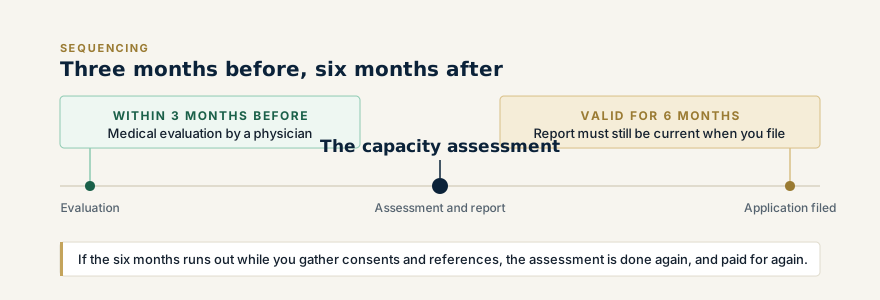
This is the part families most often discover too late, and it is easier to see than to read.
Three months before: the medical evaluation
The report requires the assessor to attest that a medical evaluation of the adult was conducted by a named physician on a stated date, and that date must fall within the three-month period immediately preceding the capacity assessment.
The point of it is to rule out causes that are temporary or reversible. An infection, a medication interaction, a delirium, an untreated condition: these can look like lost capacity and are not. Alberta insists on excluding them before anything permanent is decided about someone's rights.
What it costs
The regulations cap what an assessor may charge.
| What the assessment covers | Capped at |
|---|---|
| Personal matters only | $500 |
| Financial matters only | $500 |
| Co-decision-making | $500 |
| Both personal and financial | $700 |
The courts may allow a higher fee where the case is complex.
Then there are the costs around it.
| Other cost | Amount |
|---|---|
| Filing the court application | up to $300 |
| A review application | up to $100 |
| Background check | varies |
| Legal fees, if you use a lawyer | varies |
If the cost of the assessment itself is a financial hardship, Alberta's guidance is to contact the Office of the Public Guardian and Trustee. There is also a route for the Crown to pay a specified amount and reasonable disbursements toward the costs of the application where paying them is a hardship for the adult and the applicant, which requires proof of hardship in the costs section of the affidavit and a Hardship Application for Costs Against the Crown.
Nobody should abandon a necessary application because of the fee without asking about these first.
It expires
A completed Form 4 is valid for six months. Alberta states it two ways: the assessment must be dated within the six months before you submit your application, and the report must not be dated more than six months before the date the application is submitted.
This matters because families frequently get the assessment done first, then take months to gather consents, plans, references and background checks. If the six months runs out, the assessment is done again and paid for again.
The order that avoids paying twice
- Book the physician's medical evaluation, and note the date it happens.
- Start gathering the rest of the package: consents, the plan, personal references, the background check, and an inventory if it is trusteeship.
- Book the capacity assessment once that package is nearly complete, and inside three months of the medical evaluation.
- File the application well within six months of the assessment date.
Who sees it
Once complete, copies of the Capacity Assessment Report go to the adult, the applicant, the court, and the review officer as part of the application package.
The adult is not kept in the dark about a document concerning their own capacity. In most cases they are given the same information that goes to the court.
The application it belongs to
Form 4 travels with a package. For a trusteeship application the Office of the Public Guardian and Trustee lists it as: Capacity Assessment Report (Form 4), Application (Form 14), Affidavit of Applicant (Form 15), Trusteeship Plan (Form 34), Consent of Trustee (Form 27), Consent of Alternate Trustee (Form 29) where applicable, Inventory (Form 37) and Personal References (Form 30).
A guardianship application substitutes the Guardianship Plan (Form 32) and the guardian consents (Forms 24 and 26).
Where this sits with us
Northridge conducts designated capacity assessments under the AGTA and completes the report that results. That is regulated work with defined boundaries, and it is separate from the non-regulated navigation and administrative support we provide elsewhere.
What we will not do is tell you what the assessment will conclude before it is done. An assessment with a predetermined answer is not an assessment, and a report is only worth what its independence is worth.
If you have been asked to arrange a capacity assessment and are not sure where to start, an initial consultation is the right first step. If you are still deciding whether guardianship is what your family needs, read the five options before guardianship first, because for many families it is not.